Blog
Why I Chose Einkorn for Opaléia
Carole explains why einkorn and non-hybridised spelt guide Opaléia: their flavour, texture, cereal identity and nutritional qualities.
When I first started imagining Opaléia, I did not simply want to make good cookies and biscuits.
I wanted the dough itself to have something to say.
In many recipes, flour stays in the background. It gives structure, while most of the attention goes to chocolate, nuts, vanilla or spices.
For me, flour needed to play a bigger role.
That is what led me to einkorn.
A grain with a flavour of its own
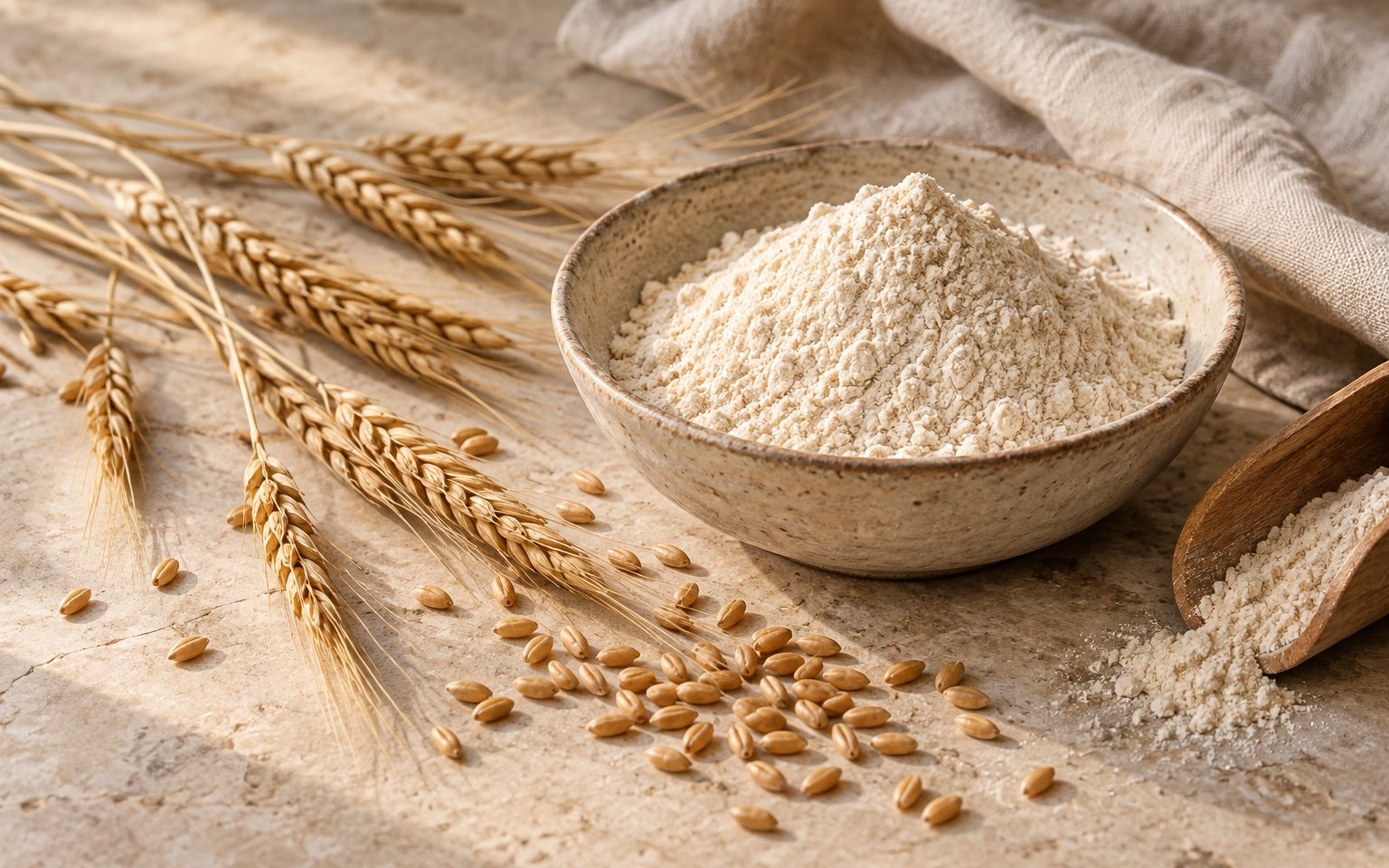
Einkorn is one of the oldest cultivated wheat species.
But its age was not what convinced me.
Its flavour was.
Einkorn flour has a distinctive cereal character, with gentle, slightly nutty notes.
It brings something to a biscuit that I do not find in the same way with ordinary wheat flour.
It is not neutral.
And that was exactly what I was looking for.
I wanted to build recipes around the grain itself, rather than simply use flour as a base for everything else.
Letting flavour begin with the flour
When we think of a cookie, chocolate usually comes to mind first.
With a shortbread biscuit, we might think about butter or vanilla.
But before all of that comes the dough.
And flour is one of its main ingredients.
I wanted it to contribute to the flavour rather than simply hold the recipe together.
With einkorn, the grain remains noticeable.
It gives the dough more depth and a distinct cereal character.
Chocolate, hazelnuts, almonds, vanilla or spices can then be added around it.
This has gradually become an important part of the way I work at Opaléia: beginning with the grain, then building the recipe around it.
A different texture
Einkorn does not only change the flavour.
It also changes the texture.
Depending on the recipe, it can produce a more delicate, crumbly or melting texture, sometimes with a slightly more pronounced cereal feel.
It does not always behave in the same way as conventional wheat flour.
The proportions may need adjusting.
Resting times may change.
Baking can require a little more attention.
That means more testing.
But I see that as part of the appeal.
A recipe becomes more than a formula to reproduce.
You have to understand the ingredient and learn how to work with it.
Flavour, but also a nutritional choice
I want to be clear: I do not present Opaléia cookies as “health products”. They remain indulgent bakes, made with butter, sugar, chocolate, nuts and other ingredients chosen for their flavour.
But flavour is not my only reason. Einkorn and spelt also interest me for their nutritional profile. At Opaléia, I choose grains that have not been hybridised with modern bread wheat: einkorn is a distinct ancient species, and the spelt I select is a non-hybridised variety. This choice helps preserve a clear cereal identity; it does not mean that the grains have never evolved or been selected over time.
Depending on the variety, growing conditions and how refined the flour is, these grains can provide protein, minerals and naturally occurring compounds such as carotenoids, which have been particularly studied in einkorn.
Einkorn and spelt both contain gluten. Their gluten has a different composition, giving a more fragile and less elastic dough.
Einkorn and spelt are therefore not suitable for people with coeliac disease or anyone who must follow a gluten-free diet.
I chose them for everything they bring together: flavour, texture, agricultural history, the non-hybridised character of the grains I select and their nutritional qualities, without turning those qualities into a medical promise.
An ancient grain, but not a nostalgic choice
The word “ancient” is used a great deal today.
Sometimes it can become little more than a marketing expression.
That is not what interests me.
What I like about einkorn is that it still has a clear identity.
Its flavour is not completely neutral.
Its flour has character.
And sometimes the recipe has to adapt to the grain rather than forcing the grain to adapt to the recipe.
That fits naturally with the way I see artisan biscuit-making.
Choosing an ingredient is not only about where it comes from or the story behind it.
What matters is what it actually brings to the finished product.
Then spelt found its place alongside it
As I developed more recipes, spelt naturally became a second part of my work.
The two grains do not give the same result.
Einkorn has a stronger cereal character, with notes that can suggest hazelnut.
Spelt is finer and more delicate. It can bring more structure to a dough while allowing other ingredients, especially chocolate, to come through more clearly.
I therefore do not see them as competing grains.
I use each one according to the recipe and the balance I am looking for.
Some creations need the character of einkorn.
Others benefit from the subtlety of spelt.
And some recipes find their balance in combining the two.
Our signature
Two ancient grains, two expressions
Einkorn
Einkorn brings a distinctive cereal flavour with delicate nutty notes and a more expressive, crumbly texture.
Spelt
Spelt offers a finer and more delicate flavour, with a structure that allows chocolate and other ingredients to come forward.
Each recipe reveals the character of its grain.
At Opaléia, ancient grains are the common thread running through every creation.
In our cookies
In a cookie, the grain has to find its place among ingredients with strong personalities.
Dark chocolate, milk chocolate, pistachio, hazelnut, almond, fruit...
The challenge is to make sure the dough does not disappear completely behind the inclusions.
I want a cookie to be generous, of course, but I also want the dough itself to have flavour.
Einkorn gives it that presence.
Spelt can bring more balance and allow the chocolate to express itself more clearly.
Depending on the recipe, I work with one or both.
In our sweet biscuits
The character of the grain is perhaps even easier to appreciate in simpler recipes.
A buttery biscuit, a vanilla sablé or a recipe with very few additional ingredients leaves nowhere for the flour to hide.
It becomes one of the main sources of flavour.
That is one of the reasons I particularly enjoy using einkorn in sweet biscuits.
It gives personality to recipes that might otherwise appear very simple.
And in our savoury biscuits
Einkorn reveals another side of itself in savoury baking.
Combined with sesame, fennel, onion, seeds or spices, its cereal flavour becomes part of the seasoning itself.
The flour is no longer there simply to give structure.
It contributes directly to the flavour of the biscuit.
I particularly enjoy this approach because it shows that ancient grains can have a place far beyond the traditional sweet cookie.
Why I still choose it today
Today, einkorn has become inseparable from the identity of Opaléia.
Not because it is fashionable.
Not simply because it is ancient.
But because it brings something real to my recipes.
Flavour.
Texture.
A nutritional profile that matters in my choice.
The non-hybridised character of the grains I select.
Personality.
And above all, a different way of thinking about the biscuit.
I do not begin only with a flavour or a chocolate and build everything around it.
I first ask myself what role the grain should play.
That is probably the simplest way to describe what I am trying to create at Opaléia:
harmony between the grain, the flavour and the texture.
Taste the two expressions of spelt
Our comparison of einkorn and non-hybridised spelt explains how each behaves in dough. To move from reading to tasting, discover the House’s artisan cookies, sweet biscuits and savoury biscuits.
To continue


